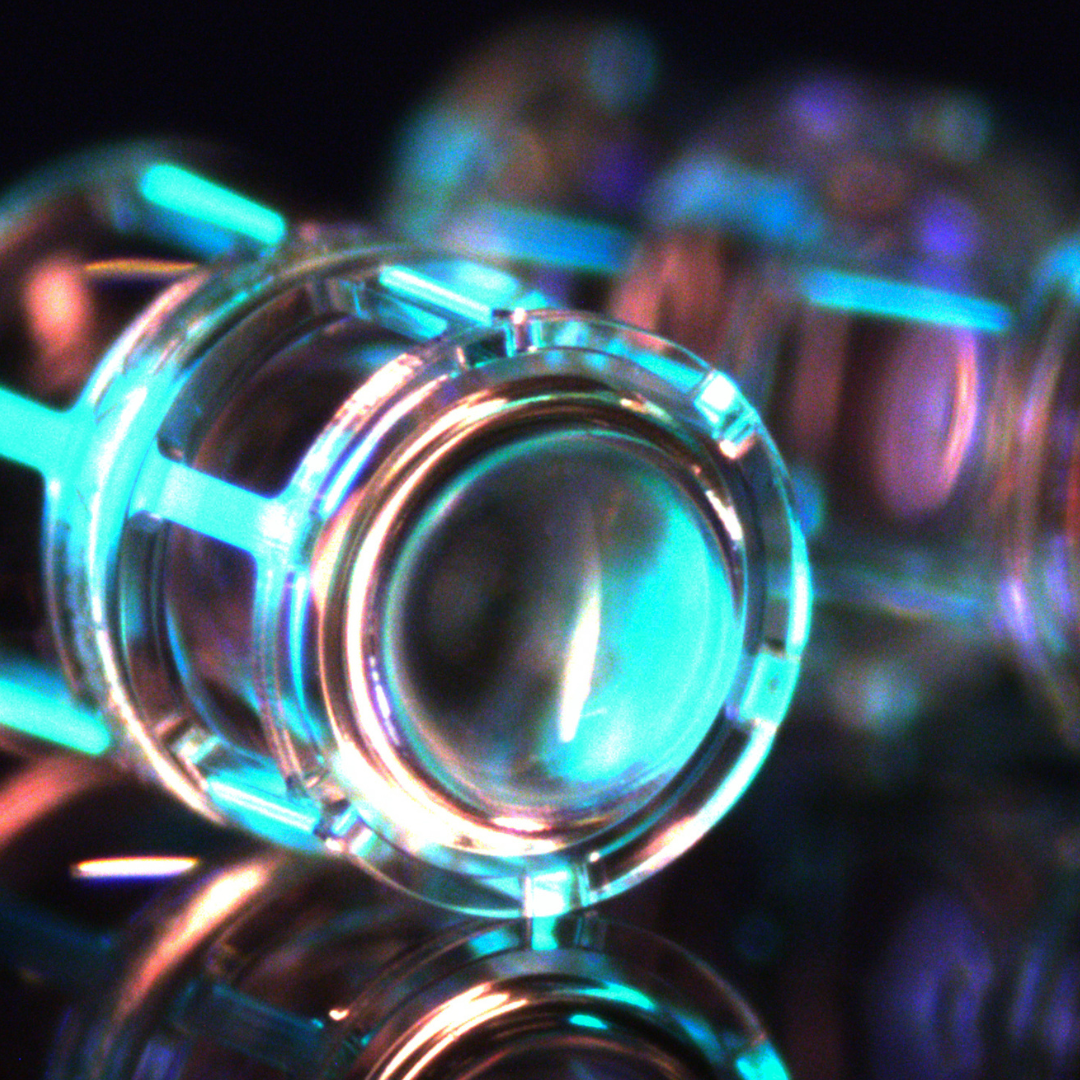




Micro Objective Lenses
-
Offering type ?
PRODUCT:
Component or system, which is commercialized. It is available for ordering multiple pieces and liability is assumed by the provider/seller. Necessary certification of the product was obtained (e.g. CE certification). The product sheet and/or conditions of use are defined.
PROTOTYPE:
Component or system, which has been successfully tested under real or real-like conditions. The prototype is not commercialized as the main purpose is to use it for demonstration and experimentation, including user and market acceptance.
TECHNICAL SERVICE:
Tools and processes and its combination, which are necessary to prepare and test prototypes or products.
- Production
- Design & Prototyping
-
Market
- Other
-
Manufacturing Pillar
- Wafer-scale
-
Technology
- 3D printing
Offering Description
Concept-to-production custom micro objective lenses through ultra-high-resolution 3D printing, combining advanced optical design with monolithic fabrication. Our objectives integrate multiple optical surfaces into a single, compact component, enabling high imaging performance while minimizing size, weight, and alignment complexity.
Micro objective lenses can be directly printed onto substrates such as image sensors, glass carriers, or fiber-based systems, allowing precise alignment and seamless system integration. Freeform surfaces and application-specific geometries enable optimization for resolution, field of view, working distance, and wavelength range. Highly transparent, low-fluorescence and biocompatible materials support demanding applications in imaging, sensing, and medical technology.
Offering Specifications
- Optical type: custom micro objective lenses
- Design freedom: freeform and application-specific surface geometries
- Numerical aperture: application-dependent, high-NA designs possible
- Integration options:
- Direct printing on image sensors or glass substrates
- Integration into compact imaging modules
- Alignment: monolithic fabrication enabling alignment-free assembly
- Surface quality: optical-grade, application-dependent
- Materials: highly transparent polymers with low autofluorescence
- Biocompatibility: suitable for medical and life-science applications
- Use cases: micro-imaging, machine vision, endoscopy, sensing